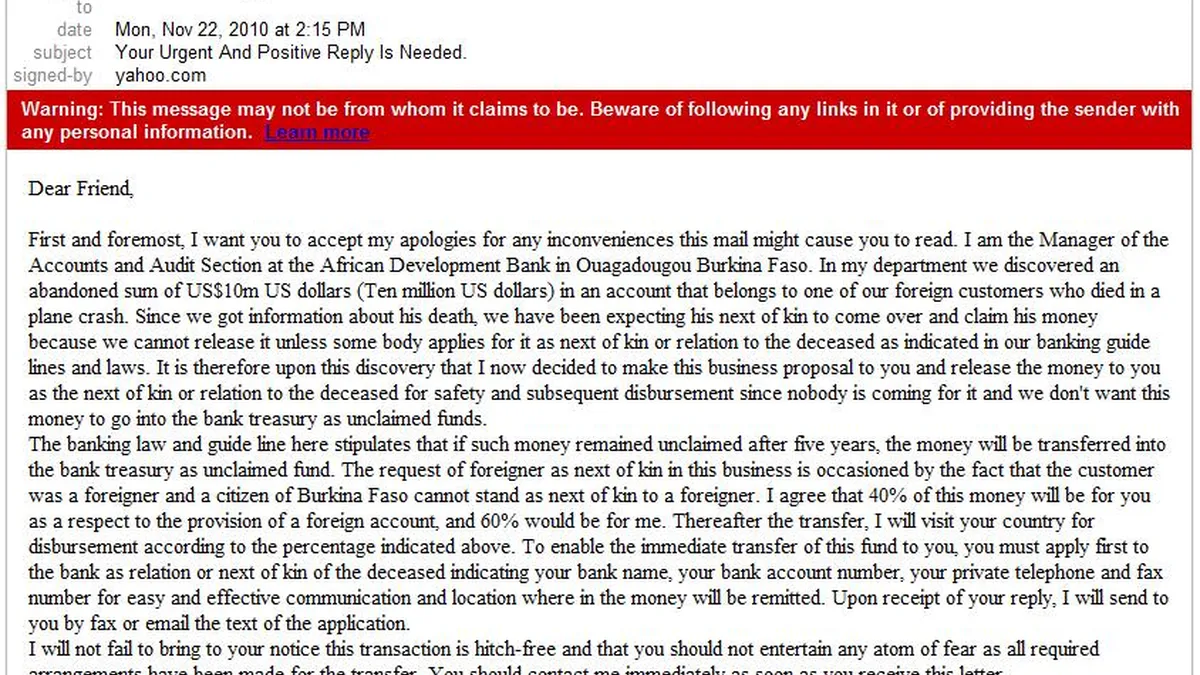
Business Email Compromise
| Also known as | Business Email Fraud, CEO Fraud |
|---|---|
| Primary target | Organizations of all sizes |
| Primary vector | Email (spoofing, account compromise) |
| Objective | Financial theft, data theft |
| Typical trigger | Deceptive request for wire transfer or sensitive data |
| Core technical control | Email authentication (DMARC, SPF, DKIM) |
| Core procedural control | Multi-person verification for financial transactions |
Origin and history
Business Email Compromise, as a distinct category of cybercrime, emerged in the early 2000s. Its origins are frequently traced to organized criminal groups operating in West Africa, particularly Nigeria, where early advance-fee fraud schemes evolved. The tactic gained significant traction and sophistication throughout the 2010s as criminals recognized the high financial yield from targeting business processes. Global law enforcement agencies, including the FBI, began formally documenting and issuing public warnings about BEC schemes around the mid-2010s. The evolution of these scams has been closely tied to the proliferation of publicly available corporate information and professional social networking sites. Criminal networks behind BEC have since expanded and diversified globally, incorporating actors from Eastern Europe and other regions into their operations.
What it is for
The primary purpose of a Business Email Compromise attack is to deceive individuals into transferring money to bank accounts controlled by criminals. It is designed to exploit the inherent trust in business communication channels, primarily email, to impersonate executives, vendors, or partners. The scheme is not for data theft or network disruption but is squarely focused on direct financial fraud. Attackers research their targets to craft credible scenarios, such as urgent invoice payments or confidential executive transactions. The end goal is always the unauthorized diversion of funds, which are then quickly laundered through multiple accounts. These attacks are engineered to bypass traditional technical security controls by manipulating human psychology rather than software vulnerabilities.
Overview
A Business Email Compromise attack is a sophisticated fraud scheme that combines social engineering, impersonation, and business process exploitation. The attack chain typically begins with thorough reconnaissance on the target organization to identify key personnel and financial procedures. Criminals then compromise or spoof email accounts to send instructions that appear legitimate, often requesting wire transfers to fraudulent accounts. A common variant involves compromising a legitimate vendor's email account and sending invoices with altered banking details to their clients. The communications are characterized by a sense of urgency, confidentiality, and authority to pressure employees into bypassing normal verification steps. Successful attacks often result in substantial, immediate financial losses that are extremely difficult to recover.
What to know
It is critical to know that BEC attacks rarely contain malicious links or attachments, allowing them to evade many email security filters. Organizations must understand that any employee involved in financial transactions or executive support is a potential target, not just those in finance departments. A key red flag is any request to change payment information or destination accounts, especially if communicated solely via email. The use of lookalike domain names, where a single character is altered, is a prevalent technique to enhance the deception. Implementing a mandatory, out-of-band verification process for all payment requests and changes to vendor details is a fundamental defensive control. Training must move beyond generic phishing awareness to include specific, procedural training on financial authorization protocols.
Common questions
A common question is whether a strong spam filter is sufficient protection, and the answer is no, as many BEC emails originate from legitimate but compromised accounts. People often ask if small businesses are targeted, and they are frequently targeted precisely because they may have less robust financial controls. Many wonder how funds are recovered, and the reality is that recovery rates are low due to the speed with which criminals move money across international borders. A frequent question concerns the role of mobile messaging, and BEC campaigns increasingly use SMS or other platforms to add pressure or bypass email scrutiny. Organizations ask if multi-factor authentication on email accounts stops BEC, and while it prevents account compromise, it does not stop email spoofing or social engineering. Individuals often question the legality of ignoring an executive's urgent request, which highlights the need for a clear, company-wide policy that prioritizes security procedures over perceived hierarchy.
Pros and cons
The primary pro of focusing on BEC defense is that it protects against one of the most financially damaging cyber threats, with potential to prevent catastrophic losses. Effective controls, like payment verification protocols, also strengthen overall financial governance and vendor management processes. A significant con is that the human-centric controls required can be perceived as bureaucratic, slowing down legitimate business transactions and causing internal friction. Organizations often regret implementing controls in a patchwork manner, such as training without procedural changes, which creates a false sense of security. A common mistake is assuming that technical email security solutions alone are adequate, leading to underinvestment in process and policy. The greatest drawback is that sustained vigilance is required, as attackers constantly adapt their stories and techniques, making defense an ongoing effort rather than a one-time fix.
Who it suits
A comprehensive BEC defense program suits any organization that conducts electronic funds transfers, regardless of its size or sector. It is particularly critical for companies with decentralized finance operations or those that frequently process large, time-sensitive payments. Organizations with extensive supply chains and numerous vendor relationships are also prime candidates due to the high risk of vendor email compromise. Businesses that have experienced rapid growth without concurrent maturation of their financial controls have an urgent need for these measures. Non-profit entities are also a strong fit, as they may be perceived as having less stringent financial oversight and are often targeted. Ultimately, any entity that cannot afford a sudden, unrecoverable financial loss must prioritize defenses against Business Email Compromise.
Latest Business Email Compromise news
Latest reporting

Former Air Force members sentenced for BEC
Two former US Air Force members stationed at Dover Air Force Base have been sentenced to a combined 189 months in prison for a business email...

Phishing Campaign Abuses Microsoft 365 Direct Send Feature
A phishing campaign exploiting Microsoft 365's Direct Send feature sent nearly 30,000 emails, primarily during US Eastern business hours, to bypass...
PEEP Malware Turns Chrome and Edge into Post-Compromise
A new post-exploitation toolkit called PEEP injects a malicious extension into Chrome and Edge browsers, allowing attackers to execute host commands...
Elementor Pro Plugin Vulnerability Actively Exploited
A critical vulnerability in the Elementor Pro WordPress plugin is being exploited to upload malicious PHP files, allowing attackers to compromise...

Microsoft Warns of High-Volume Phishing Campaign Using
Microsoft has alerted of a phishing campaign using invisible Unicode tag characters to split financial keywords and evade email filters, with peak...

BraZetsu Malware Fuels Criminal Access Marketplace
Group-IB researchers detail the BraZetsu malware framework, used by the Exilware group to compromise Windows hosts and sell access on an underground