Identity And Access Management
| Vulnerability type | Configuration and policy flaw |
|---|---|
| Primary impact | Unauthorized access and privilege escalation |
| Typical root cause | Weak or misconfigured identity controls |
| Common control | Identity governance and privileged access management (PAM) |
| Detection method | Configuration audit and access review |
| Prevention strategy | Principle of least privilege and multi-factor authentication |
| Remediation action | Review and enforce access policies |
Origin and history
The conceptual framework for Identity and Access Management (IAM) emerged from the need to manage user identities and permissions within early multi-user computer systems developed in the United States during the mid-20th century. Its foundational principles were solidified alongside the rise of enterprise networks and mainframe computing in the 1970s and 1980s. The formalization of IAM as a distinct cybersecurity discipline accelerated in the 1990s with the commercialization of the internet and the proliferation of client-server architectures. The development of standardized protocols like LDAP (Lightweight Directory Access Protocol) in the early 1990s provided a crucial technological cornerstone for directory services. The evolution of IAM continued into the 2000s with the advent of federated identity standards such as Security Assertion Markup Language (SAML), enabling cross-domain access. Today, IAM is a mature, critical component of any organization's security infrastructure, continuously adapting to cloud computing and zero-trust models.
What it is for
Identity and Access Management exists to ensure that the right individuals can access the appropriate resources at the right times for the right reasons. Its primary function is to manage the full lifecycle of digital identities, from initial provisioning to eventual de-provisioning when a user leaves an organization. IAM systems enforce organizational policies that govern user access to networks, systems, applications, and data based on their roles. A core objective is to implement the principle of least privilege, granting users only the minimum access necessary to perform their job functions. It provides the mechanisms for strong authentication, verifying that users are who they claim to be before granting access. Furthermore, IAM enables accountability by creating a definitive audit trail of who accessed what resource and when, which is essential for security investigations and regulatory compliance.
Overview
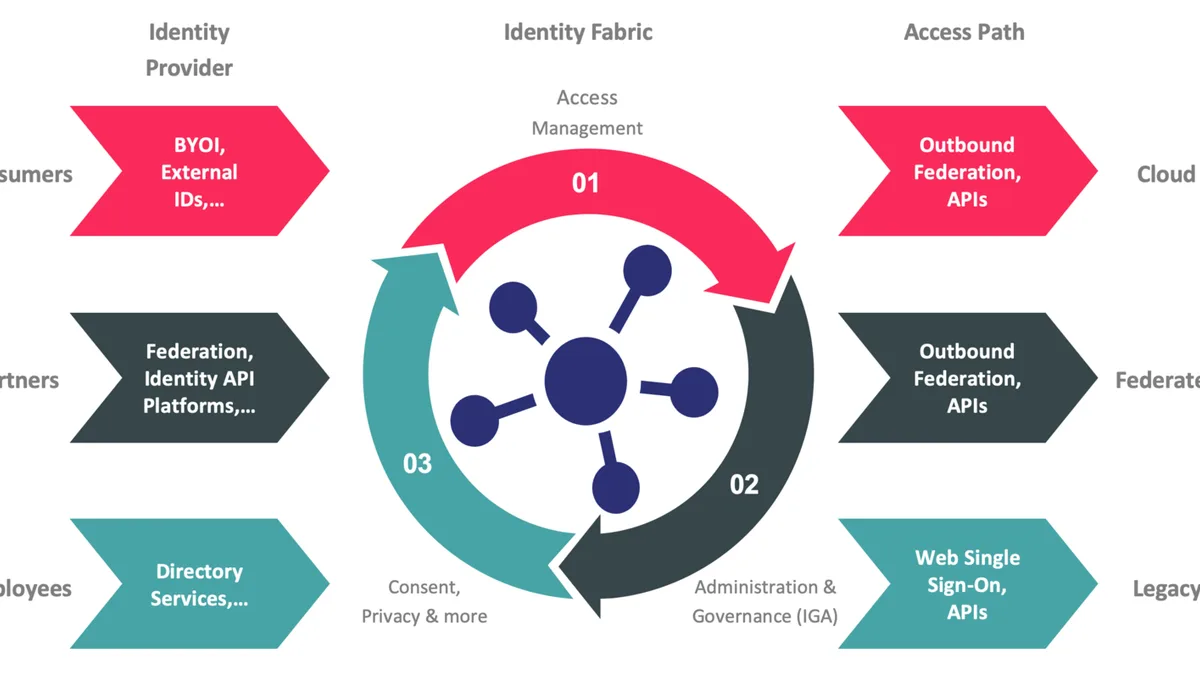
Identity and Access Management is a framework of policies, processes, and technologies used to manage digital identities and control user access to critical information within an organization. The framework typically encompasses several key components, including identity governance, access management, privileged access management (PAM), and directory services. Identity governance involves defining and managing user roles, access requests, certifications, and policies to ensure compliance. Access management handles the authentication and authorization processes, often using single sign-on (SSO) and multi-factor authentication (MFA) mechanisms. Directory services, such as Microsoft Active Directory, act as a central repository for user identity information. Modern IAM solutions extend these capabilities to cloud applications and services, managing identities across hybrid environments and supporting identity federation for partnerships.
What to know
A fundamental concept in IAM is the distinction between authentication (verifying identity) and authorization (granting permissions), which are separate but interdependent processes. Organizations must understand that IAM is not a one-time project but an ongoing program requiring continuous management of user lifecycles, including joiner-mover-leaver processes. The principle of least privilege is a critical security best practice that should be enforced through role-based access control (RBAC) or attribute-based access control (ABAC). Implementing strong multi-factor authentication is now considered a baseline requirement for protecting sensitive systems and data from credential-based attacks. IAM programs must also address the security risks posed by non-human identities, such as service accounts and application APIs, which often have excessive privileges. Compliance requirements from regulations like GDPR, HIPAA, and SOX heavily influence IAM strategies, mandating strict access controls and detailed audit logs.
Common questions
How does IAM differ from simple username and password logins? IAM is a comprehensive framework that goes beyond basic credentials to include centralized management, policy enforcement, lifecycle management, and advanced authentication. What is the relationship between IAM and Privileged Access Management? PAM is a subset of IAM focused specifically on securing, monitoring, and managing accounts with elevated permissions, such as administrators. Can IAM work for cloud-based applications? Yes, modern cloud IAM solutions and identity-as-a-service (IDaaS) platforms are designed specifically to manage access to software-as-a-service applications and infrastructure. What is single sign-on and how does it relate to IAM? SSO is an authentication scheme within IAM that allows a user to log in once and gain access to multiple systems without re-entering credentials, improving user experience and security. Why is de-provisioning access so important? Failure to promptly remove access when users change roles or leave the organization is a major security vulnerability, leaving orphaned accounts active. What are the main challenges in implementing IAM? Common challenges include complex legacy system integration, managing the sheer scale of identities, user resistance to new processes, and ensuring consistent policies across hybrid IT environments.
Pros and cons
A primary advantage of a robust IAM program is significantly enhanced security posture through enforced least-privilege access, reduced attack surface from orphaned accounts, and strong authentication, directly mitigating risks like credential theft and insider threats. It also delivers substantial operational efficiency by automating user provisioning and de-provisioning, reducing IT helpdesk workload for password resets, and streamlining access reviews for compliance. Furthermore, it improves the user experience with capabilities like single sign-on, eliminating the need to remember numerous passwords for different applications. However, IAM implementations are notoriously complex and expensive, often requiring significant upfront investment in software, specialized skills, and process redesign, with projects sometimes failing to deliver expected ROI. A common mistake is treating IAM as a purely technological deployment without aligning it with business processes, leading to poor adoption, policy exceptions, and shadow IT that undermine security. Organizations frequently regret choosing overly complex suites without the internal expertise to manage them, or they underestimate the ongoing administrative burden of role management and access certifications, which can become a major operational drain.
Who it suits
Identity and Access Management is an essential requirement for any organization of significant size that manages digital access for employees, contractors, or customers, particularly those in regulated industries like finance, healthcare, and government. Large enterprises with complex IT landscapes, numerous applications, and hybrid cloud environments benefit most from the centralized control and visibility a mature IAM program provides. It is also critically suited for organizations that must demonstrate compliance with strict data protection and privacy regulations, as IAM systems provide the necessary audit trails and access controls. Companies with a high turnover of staff or contractors require strong IAM to efficiently and securely manage the constant cycle of access grants and revocations. Conversely, very small organizations with a handful of users and simple IT needs may find a full-scale IAM suite unnecessarily complex, often managing adequately with built-in OS user management and basic cloud directory tools until they reach a scaling inflection point.
Latest Identity And Access Management news
Latest reporting

NetScaler CVE-2026-88772 Exploitation Deploys Root Malware
Attackers are actively exploiting a critical Citrix NetScaler zero-day, CVE-2026-88772, to gain root access and deploy custom WHIPSHOT and SLAPSHOT...

OnePlus OxygenOS root exploit disclosed
Researcher Rasmus Moorats chained two unpatched OnePlus software flaws to gain root access on an Android phone via a malicious app requiring no

Check Point Zero-Day Exploited in Targeted July Attacks
Check Point has disclosed that a critical zero-day vulnerability in its Security Management Server was exploited in targeted attacks in July.

AI-Generated Exploit and Token Flaw Breached OpenAI Internal
Researchers used an AI model to build an exploit for an unpatched library flaw, chaining it with an OpenAI sign-in token vulnerability to access...

Google Play Early Access Abused for Deceptive Android Apps
Threat actors are exploiting Google Play's Early Access program to distribute thousands of deceptive apps, including fake casino games and reward...

Doppler Secrets Platform Secures AI Agents and Pipelines
Doppler's secrets management platform centralizes credentials for developers, CI/CD pipelines, and AI agents, addressing credential leakage risks with